

Studying alone is hard. The plan that feels solid on Sunday evening is usually gone by Tuesday afternoon. Studying with friends is one of the simplest fixes there is: when someone expects you to show up, you show up, and when you can see them working, it is easier to keep going yourself.
It can also turn into two hours of talking and ten minutes of work. The difference is structure. This guide covers how to run a study session with friends that stays productive, how to study together online when you are not in the same place (including live study rooms and study challenges), and how to keep a group going for a whole term instead of one evening.
The short version
- Agree on one task each before you start, and say it out loud.
- Use a timer: 25 minutes of work and a 5-minute break, or 50 and 10.
- Phones away, and no talking until the break.
- Finish with a two-minute check-in: what did you get done?
- Not in the same place? Sit in the same online study room, or start a challenge that counts everyone’s study time.
- Keep it going with something everyone can see: a shared goal, a streak or a weekly ranking.
Why studying with friends works
There is nothing magic about it. It works for a few plain reasons:
- You actually start. Starting is the hardest part of studying. A fixed time with a friend removes the “maybe later” decision.
- Someone can see you. When a friend can see whether you studied today, a private promise becomes a shared one, and most people keep those more often.
- Other people working makes focus feel normal. Next to someone who is focused, scrolling feels strange. That is the same reason it is easier to work in a library or a study café than in your bedroom.
- You can test each other. Explaining a topic to a friend, or answering their questions, shows you quickly what you do not understand yet. That is far more useful than reading your notes again.
- It becomes a habit. One great session does not change much. Studying a little on most days does, and a group helps you keep that rhythm.
Why study sessions with friends go wrong
If you have tried this before and it fell apart, it was probably one of these:
- No plan. “Let’s study” with no task means nobody knows when to start.
- Talking is the default. If someone has to ask for quiet every few minutes, it will not stay quiet.
- Phones on the table. One notification, and the whole table is watching a video.
- Different goals. One person is cramming for tomorrow, another is reading ahead. Their energy does not match.
- The wrong people. Your favourite person to hang out with is not always your best study partner.
Every step below fixes one of these.
How to run a study session with friends that stays productive
1. Keep the group small and pick the right people
Two to four people is easiest. Pick friends who also want to get work done that day. You do not need to study the same subject. Some of the best study partners take completely different courses, because there is less to chat about.
2. Agree on the plan in two minutes
Before anyone opens a book, each person names one specific task: “finish chemistry questions 1 to 10”, not “do chemistry”. Write the tasks down or drop them in your group chat, so you can check them off at the end.
3. Use a timer for every block
Work in fixed blocks with short breaks. The Pomodoro technique (25 minutes of work, 5 minutes of break) suits most groups. If everyone is doing deep, slow work, try 50 and 10. One person runs the timer for the whole group, so nobody debates when to stop. Any timer works, including a Pomodoro timer app.
4. Phones away, talking only on breaks
Phones go in a bag or another room, not face down on the desk. Talking waits for the break. If you get stuck on a question, write it down and ask on the break. Often you will have worked it out by then.
5. Use the last break to test each other
Swap flashcards, ask each other three questions, or explain one idea in a minute. This is the part of studying together that you cannot get on your own, so do not skip it.
6. End with a check-in and book the next session
Spend two minutes going round the group: what did you finish, what is left, and when is the next session? Booking the next one right away is what turns a good evening into a routine.
A two-hour session plan you can copy
- 0:00 to 0:05: say your tasks, put phones away
- 0:05 to 0:30: focus block 1
- 0:30 to 0:35: short break
- 0:35 to 1:00: focus block 2
- 1:00 to 1:15: long break: snack, stretch, chat
- 1:15 to 1:40: focus block 3
- 1:40 to 1:50: quiz each other on what you studied
- 1:50 to 2:00: check-in and book the next session
How to study with friends online
You do not have to be in the same room. Here are the main ways to study together from home, from the most “together” to the most independent.
Option 1: a video call with cameras on
Start a call on whatever app your group already uses, turn cameras on, mute microphones and follow the same plan as above. Seeing faces keeps some people honest. The downsides: you need a quiet space you are happy to show, video drains battery and data, and with everyone unmuted it is easy to drift into chatting. One tip: let one person run the timer and say “break” out loud, so everyone stops and starts together.
Option 2: a live study room, without a camera
A virtual study room gives you the “someone is studying next to me” feeling without video. In Lilo, the study rooms are live 3D spaces: the Classroom, the Café, the Library and the Seaside terrace, plus seasonal rooms. You pick a desk, your own 3D character sits down and your timer runs. Everyone in the room has a name tag with their country flag and their live study time, so you can see who has been at it the longest. Lilo does not use your camera or microphone.
 The Café study room in Lilo. Everyone at a desk is studying right now.
For friends, you open a private room and share a 6-character code or an invite link. Private rooms have a chat, so you can say hi before you start and check in on breaks. Public rooms have no chat, which keeps them quiet, but you can wave at the people around you.
This works well when your schedules do not line up. If your friend is not online yet, you can sit in a public room with other students and get started anyway.
Option 3: a study challenge, from anywhere
Sometimes you cannot study at the same time at all: different timetables, part-time jobs, time zones. A study challenge solves that. Instead of sitting together, you agree on a goal, and everyone’s study time counts toward it whenever they study.
In Lilo you can start four kinds of study challenges with friends:
- Time goal: everyone works toward a set amount of study time.
- Speed race: the first person to reach a study-time target wins.
- Ranking battle: a live ranking of who studies the most.
- Streak: who can keep studying day after day for longest.
Between challenges, a friends feed and rankings show how everyone is doing.
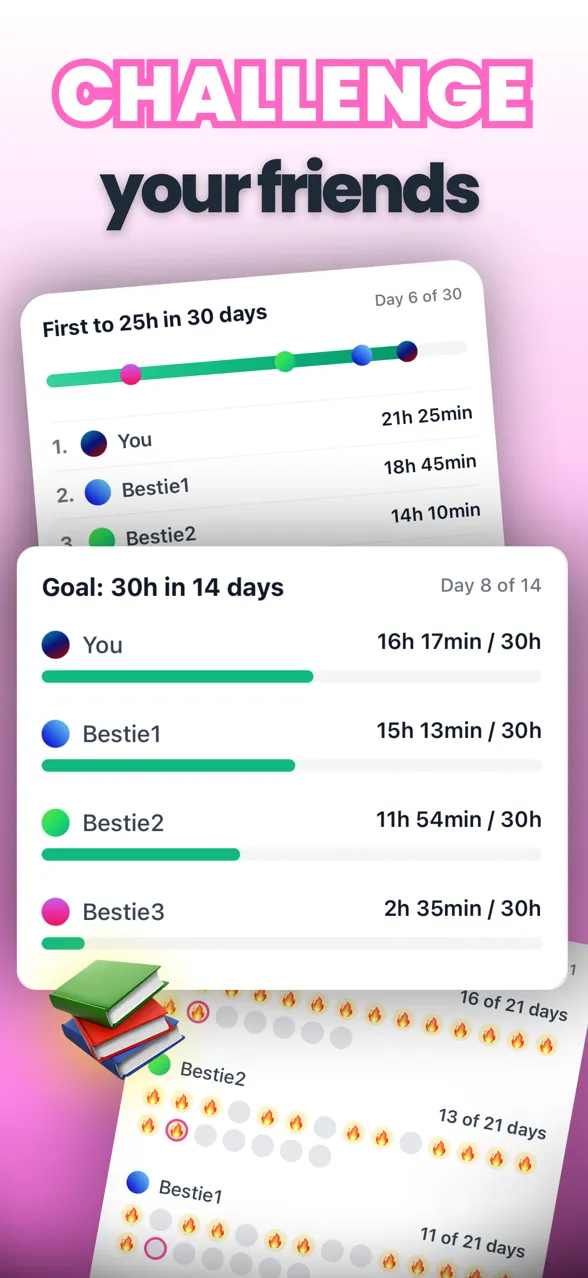 A speed race, a shared time goal and a streak, each with live progress for every friend.
6 study challenge ideas for friends
You can run these in Lilo or with a shared note and screenshots. What matters is a clear goal and a clear end date.
- The exam countdown (time goal). Two weeks before an exam, everyone aims for 10 hours of focused study. Everyone can reach it, so nobody feels left behind.
- The weekend sprint (speed race). First to 4 hours between Saturday morning and Sunday night wins. A good way to kick off a revision weekend.
- The 7-day streak (streak). Study at least once every day for a week. Short sessions count. This is the best challenge for building a habit.
- The exam month leaderboard (ranking battle). A ranking over the whole exam period, with a small prize: last place buys the coffee. Best for groups that enjoy competing.
- The new term starter (streak). Keep a 14-day streak in the first two weeks of term, when a new habit is easiest to set.
- The one-hour week (time goal). Everyone does one hour of focused study every day this week, any subject.
Match the challenge to the group. If someone tends to fall behind, start with a shared time goal or a streak. Save ranking battles for friends who like competing, because finishing last every day does not motivate everyone.
How to keep a study group going all term
- Fixed times. “Tuesdays and Thursdays at 6” beats “let’s study sometime”.
- Progress you can see. Streaks and shared study time make effort real, not just claimed. In Lilo, you can protect your streak with XP you have earned, so one missed day does not wipe out weeks of work. More on this in how to build a study streak.
- Small wins. React to each other’s sessions, celebrate a finished chapter, and notice when someone comes back after a bad week.
- Take turns organising. If one person always picks the time and opens the room, they burn out. Rotate it.
- A weekly reset. Spend five minutes on Sunday planning the week together. Our guide on how to plan your study week has a simple method.
- No guilt for missed days. When someone misses, welcome them back. Shame makes people go quiet, not study more.
Common problems and how to fix them
- “One friend always talks.” Make talking a break-only thing and agree on it before the first block. Online, use a room without chat for the work blocks.
- “Someone keeps cancelling.” Switch to a challenge that counts study time whenever they do it, so they can take part without matching your schedule.
- “We study different subjects.” That is fine, and often better. The point is to work side by side, not to study the same thing.
- “Competition makes me feel worse.” Use a shared time goal or a streak instead of a ranking, so the group wins together.
- “We live in different time zones.” Run a challenge, and drop into a live room when you can.
- “My phone still distracts me.” Studying with others helps you start, but it will not lock your phone. Put it in another room for the work blocks, or turn on Do Not Disturb so notifications wait until the break. Our guide on how to stay focused while studying has more ideas.
How to set it up in Lilo
Disclosure: Lilo is our app, made by our studio, Pado Apps.
- Download Lilo on iPhone, iPad or Android. It is free.
- Create your 3D character.
- Open a private room and share the 6-character code or the invite link in your group chat.
- Everyone picks a desk and starts a session. The free timer is a countdown with four scenes: Classic, Coffee, Sleeping cat and Rainy window. Set it to 25 minutes for a Pomodoro-style block.
- Start a challenge for the week. A time goal is a good first one.
Free in Lilo: the countdown timer, live study rooms, private rooms with chat, your 3D character, challenges with friends, the friends feed and rankings, streaks, 101 levels where the mascot Lilo changes outfit, a day planner with up to 2 tasks a day and some study music. Lilo Premium adds Stopwatch and Pomodoro modes, 30+ more timer scenes, the full music library, unlimited challenges and planning, advanced stats and extras for your character and room.
Two things Lilo does not do: it does not block other apps, and it has no web or PC version, so it is not the right pick if your group studies on laptops only.
Studying with friends will not do the work for you, but it makes the work easier to start and harder to skip. Pick one friend, book one session this week and keep the rules simple. If it helps, you will know after the first check-in.
Frequently asked questions
How do you study with friends online?
Pick a start time, agree on one task each and work in timed blocks, with talking saved for breaks. You can do it on a video call, in a live study room app like Lilo where you sit at desks as 3D characters with no camera, or at a distance with a study challenge that counts everyone's study time.
Is it better to study alone or with friends?
Both have a place. Friends help you start, keep you accountable and are great for testing each other. Studying alone is better for hard work that needs total quiet. Many students work side by side in silence, then quiz each other at the end.
How do you study with friends without getting distracted?
Set the rules before you start: one task each, phones away, a timer for every block and no talking until the break. Finish with a two-minute check-in where everyone says what they got done.
Can you study with friends online without a camera?
Yes. In Lilo's live study rooms you appear as your own 3D character at a desk, with a name tag, country flag and live study time. Lilo does not use your camera or microphone. Private rooms for friends have a chat.
What is a good study challenge to do with friends?
Start with a shared time goal, like 10 hours each before an exam, because everyone can reach it. Once the group has a rhythm, try a speed race to a set number of hours, a ranking battle for the week or a daily streak.
What app can I use to study with friends?
Lilo lets you open a private 3D study room with a 6-character code or invite link, with a chat for breaks, and start study challenges with friends: a time goal, a speed race, a ranking battle or a streak. If your group wants to see each other on camera, any video call app you already use works too.
Keep reading
 8 Best Back to School Apps for Students in 2026 The 8 best back to school apps for students in 2026: apps to focus, organise your semester, learn a language, meet deadlines and get homework help.
 10 Best Study Apps for Students in 2026 (Mostly Free) 10 study apps compared by job: focus, notes, planning, languages and homework help. What each does for free, what costs money and who should skip it.
 How to Build a Study Streak That Actually Sticks A study streak turns studying into a daily habit. Here's how to start one, keep it alive on busy days, and recover when you slip, without burning out.